
Modern Data Warehouse Consultancy for UK Businesses
Build a fast, scalable, cost‑efficient data warehouse that delivers reliable reporting, better decision‑making, and long‑term ROI.
We design, modernise, and optimise data warehouses using Microsoft Fabric, BigQuery, SQL, and Power BI — tailored to your business, not generic templates.
Why Your Business Needs a Modern Data Warehouse
Most organisations now rely on data for reporting, forecasting, and operational decision‑making – but their warehouse is the bottleneck.
Common Issues We Fix:
Slow Reporting
Slow or unreliable reporting that delays critical business decisions
Siloed Data
Multiple versions of the truth across different departments
Over-Engineered Pipelines
Bloated data pipelines that cost too much to run and maintain
Legacy SQL Systems
Outdated SQL systems that can’t scale with your growth
Missing Semantic Layer
No unified semantic layer or KPI alignment across tools
Inconsistent Dashboards
Dashboards built on unreliable or messy underlying data
A modern Data Warehouse solves these problems by creating a single, trusted, scalable source of truth.

Our Data Warehouse Consultancy Services
Our Data Warehouse Consulting Service offerings include some cutting edge technologies.
BigQuery Consulting
Leverage Google’s powerful, serverless data warehouse solution with our Google BigQuery expertise:
- Optimize query performance and cost efficiency
- Implement best practices for data modeling and schema design
- Seamless integration with Google Cloud Platform services
Learn more about our BigQuery Consulting Services
Snowflake Consulting
Harness the power of Snowflake’s cloud data platform with our specialized consultancy:
- Data migration and integration strategies
- Performance optimization and cost management
- Security and governance implementation
- Cost Optimisation
Microsoft SQL Consulting
Enhance your data management and querying capabilities with our Microsoft SQL consultancy. Where you are using Microsoft SQL Server, or Azure SQL we can help
- Advanced SQL query optimization and tuning
- Database design and normalization
- Stored procedure and function development
- Migration from on premise to Cloud
Learn more about our SQL Server Consulting Services
Our Data Warehouse Consultancy Approach
Our Standard Data Warehouse Consultancy Process.
Our consultancy project normally follows a five-stage process. Depending on the complexity of the project
Step 1 - Initial Meeting
To begin with a complimentary exploratory call to understand your specific needs and goals. We gain an outline understanding of your business, your data and your current infrastructure and your costs. We will review the scalability of your current offering.
Step 2 - Top Level Plan
We work closely with your team to execute the strategy, providing hands-on guidance and support.Our experts develop a tailored plan aligned with your business objectives. We enhance this outline and map the data together to form a top-level plan, with important areas of priority planned in first. We further define your requirements to deliver a data strategy in line with your KPIs and objectives
Step 3 - Develop Solution
Following the strategy, we begin to develop the priority areas for your business. We work as close as possible with your team, bringing them on the journey with us and gearing up their knowledge in readiness for them to be able to fully support day to day operations.
Step 4 - Training and Handover
We ensure your team gains valuable insights and skills throughout the process. When we get to the point of handover, we focus more on making sure that any knowledge gaps in your teams are addressed and clear documentation is provided and hosted on your systems.
Step 5 - Ongoing Support
We provide a range of on-going support options to ensure longer term success.

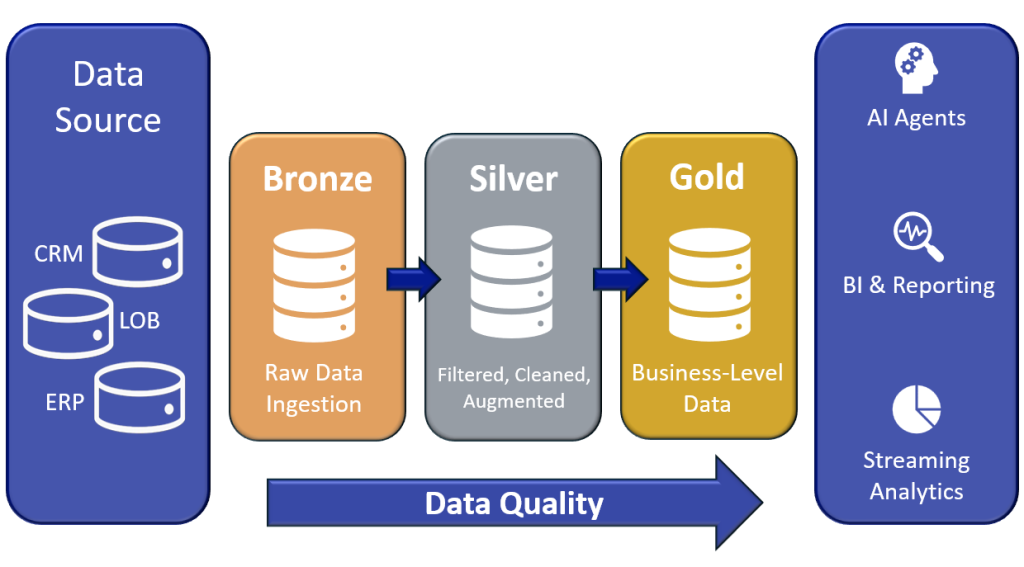
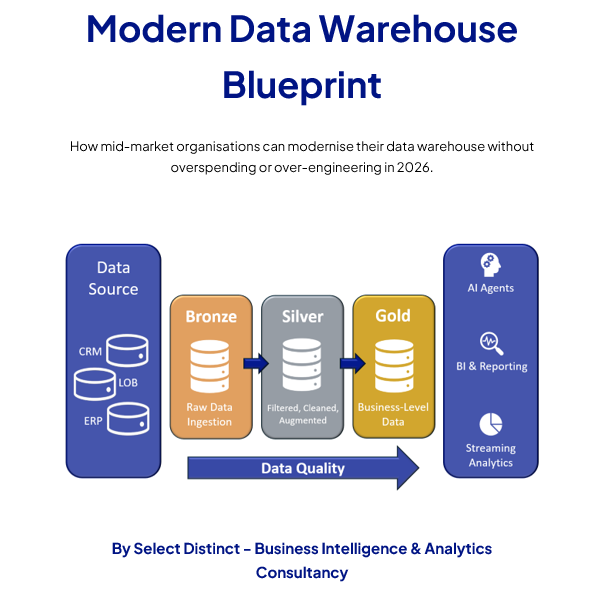
Our Approach: The Modern Data Warehouse Blueprint
We use a proven 5‑layer architecture that delivers speed, reliability, and long‑term scalability.
1. Ingestion Layer
Automated, monitored pipelines from:
- CRM
- ERP
- Finance systems
- GA4
- Operational databases
- Cloud apps
- Excel/Sheets (yes, still happens)
2. Storage Layer (Bronze)
Fabric Lakehouse or BigQuery:
- Low‑cost storage
- Scalable compute
- Partitioning & clustering
- Secure, governed access
3.Transformation Layer (Silver)
SQL or dbt:
- Business logic
- KPI definitions
- Incremental models
- Data quality tests
- Reusable transformations
4. Semantic Layer (Gold)
The most important part:
- Clean, consistent tables
- Star schema
- Naming conventions
- Reusable measures
- KPI dictionary
5. BI (or AI) Layer
Power BI, Google Data Studio:
- Executive dashboards
- Operational dashboards
- Self‑service analytics
- Governance & adoption
AI Agents:
- Natural language querying
- Model context protocol (MCP)
- Non technical users
This blueprint ensures your warehouse is fast, maintainable, and future‑proof.
What You Get When You Work With Us
Warehouse Built for Business
Not just a technical asset – strategic driver for growth.
Lower Long-Term Costs
Lean architecture, fewer tools, and reduced maintenance overhead.
Faster Reporting
Dashboards that refresh reliably and run at peak performance.
Clear, Consistent KPIs
One single version of the truth across your entire organisation.
Scalable Architecture
Future‑proof foundations ready for AI, predictive modeling, and expansion.
True Partner
Consultants fluent in BI, SQL, Fabric, BigQuery, and Power BI who focus heavily on business value.
Trusted by Organisations






Industries We Work With
Helping organisations consolidate data from multiple systems into a scalable, trusted source for reporting and analytics.


Why Organisations Choose Select Distinct
Data Warehouse Design & Implementation Specialists
Unified Data For Consistent, Trusted Reporting
Scalable Foundations For Power BI & Business Intelligence
Independent, Practical & Commercially Focused Advice
Examples of Our Data Warehouse Projects
Explore how we’ve helped organisations build scalable data warehouses, modernise data integration processes and create trusted foundations for business intelligence, data analytics and reporting.
Discover how our consultancy services have enabled improved data governance, streamlined reporting workflows and more effective decision-making across the organisation.


Data Warehouse Technologies & Resources
You can read all of our Data Warehouse archives here


Modern Data Warehouse Blueprint
A practical guide to designing a scalable data warehouse for reporting, analytics and AI.
Data Warehouse FAQs
What is a data warehouse and why does my business need one?
A data warehouse is a centralised repository that combines data from multiple systems into a single, trusted source for reporting and analytics. It helps organisations improve data quality, eliminate reporting inconsistencies and create a foundation for business intelligence tools such as Power BI.
What are the signs that my business needs a data warehouse?
You may benefit from a data warehouse if your organisation relies on multiple spreadsheets, struggles with inconsistent reporting, spends excessive time preparing reports, or has data spread across several systems. A data warehouse helps create a single source of truth that improves reporting accuracy and efficiency.
Can you integrate data from multiple systems into a data warehouse?
Yes. We can consolidate data from ERP systems, CRM platforms, accounting software, operational databases and other business applications into a single data warehouse, making it easier to analyse and report on business performance.
How long does a data warehouse implementation take?
The timeline depends on the complexity of your requirements, the number of data sources and the volume of data involved. Smaller projects can often be delivered within a few weeks, while larger enterprise data warehouse implementations may take several months.
Can a data warehouse support Power BI and other business intelligence tools?
Absolutely. A well-designed data warehouse provides the foundation for Power BI, Tableau and other business intelligence platforms, ensuring faster performance, more reliable reporting and scalable analytics capabilities.