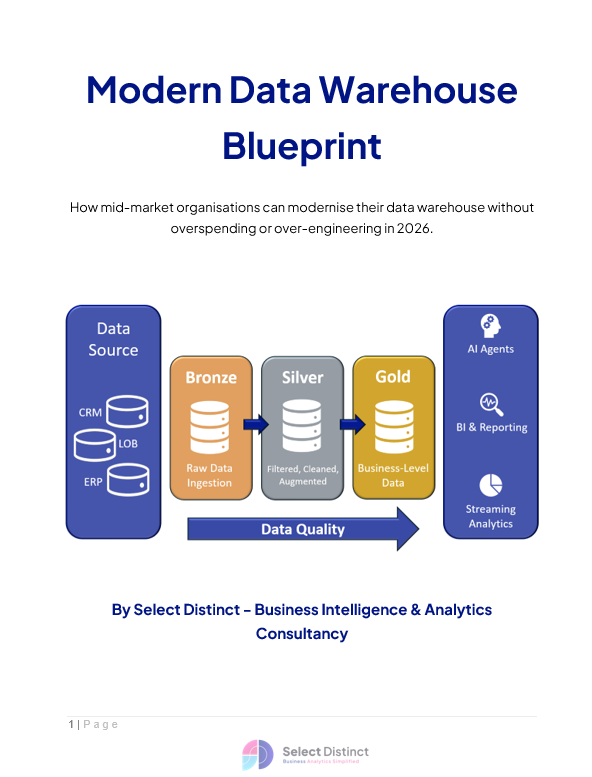
A practical, commercially‑focused guide for mid‑market organisations in 2026
Executive Summary
Most organisations now rely on data for reporting, forecasting and operational decision-making, but their data warehouse is often the weakest link. Legacy systems are slow, expensive to maintain and unable to support modern analytics workloads. Many organisations address these challenges through Data Warehouse Consulting, helping them modernise architecture, improve governance and build a scalable foundation for analytics.
Strategic Insight
“A modern data warehouse should be lean, scalable, governed, and aligned to business outcomes, not just technology choices.”
According to Databricks, warehouse modernisation is now a strategic initiative that aims to reduce total cost of ownership, improve performance, and support AI workloads. This guide outlines the strategy we use to help UK businesses modernise their data warehouse without overspending or over-engineering.
Want the full Modern Data Warehouse Blueprint? Get the complete 5‑layer architecture, Medallion model, and AI agent roadmap. Download the free PDF
1. Why Most Data Warehouses Fail
Industry research shows that most warehouse problems are not platform issues — they are design and process issues such as vague requirements, brittle pipelines, stale data, and unclear permissions.
- Dashboards built on inconsistent data
- Slow refreshes and unreliable pipelines
- Over-engineered architectures with too many tools
- No semantic layer or KPI dictionary
- High maintenance overhead
- Legacy SQL systems that can’t scale
- Data scientists and analysts fighting over access
These issues compound over time, making reporting slower and less trustworthy.
2. Start With Business Objectives — Not Technology
Databricks emphasises that effective warehouse design begins with aligning stakeholder reporting needs before selecting any schema or storage technology.
- Identify the decisions the warehouse must support.
- Map personas (executives, analysts, data scientists) to their data needs.
- Define measurable outcomes (e.g., “reduce reporting time by 50%”).
- Prioritise KPIs and metrics before modelling.
Skipping this step leads to technically correct systems that nobody uses.
3. The Modern Data Warehouse Blueprint (2026 Edition)
A modern warehouse follows a layered architecture that separates ingestion, storage, transformation, semantic modelling, and BI delivery. This aligns with the three-tier architecture described in Databricks’ design guide.
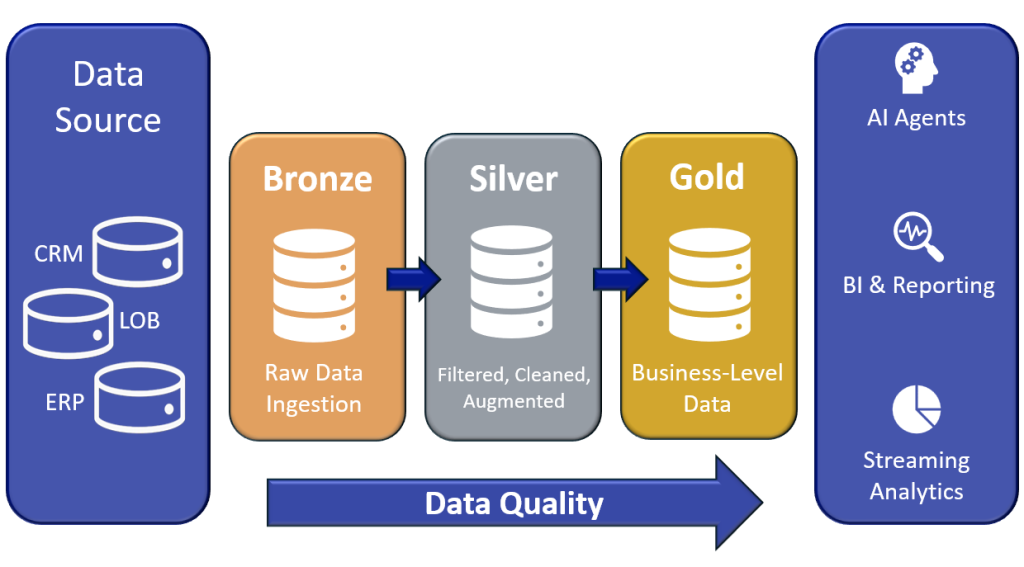
Layers:
1- Ingestion: Use incremental loading or CDC (Change Data Capture) to avoid full reloads. Sources include CRM, ERP, Finance, GA4, and SaaS.
2 – Storage: Cloud-native storage like Microsoft Fabric Lakehouse or Google BigQuery for low-cost storage and scalable compute.
3 – Transformation: Use SQL or dbt to build incremental models and add data quality tests.
4 – Semantic Layer: The most critical layer. Implements star schema modeling to ensure one version of the truth.
5 – BI Layer: Powered by Power BI, Looker Studio, or Fabric Direct Lake mode for executive and operational dashboards.
4. Cost Mistakes That Waste Money
The biggest financial drains in mid-market data infrastructure:
- Too many tools: Multiple ingestion tools, storage layers, and BI tools create unnecessary complexity.
- Over-engineered pipelines: Pipelines should be simple, incremental, and testable – not sprawling DAGs.
- Missing data quality tests: Bad data leads to bad decisions and expensive rework.
- Absence of a KPI dictionary: Executives lose trust when KPIs differ across dashboards.
- Zero governance: Governance is essential for trust, security, and compliance at scale.
- Rebuilding instead of modernising: Many legacy warehouses can be modernised rather than replaced entirely.
5. What a Good Data Warehouse Delivers
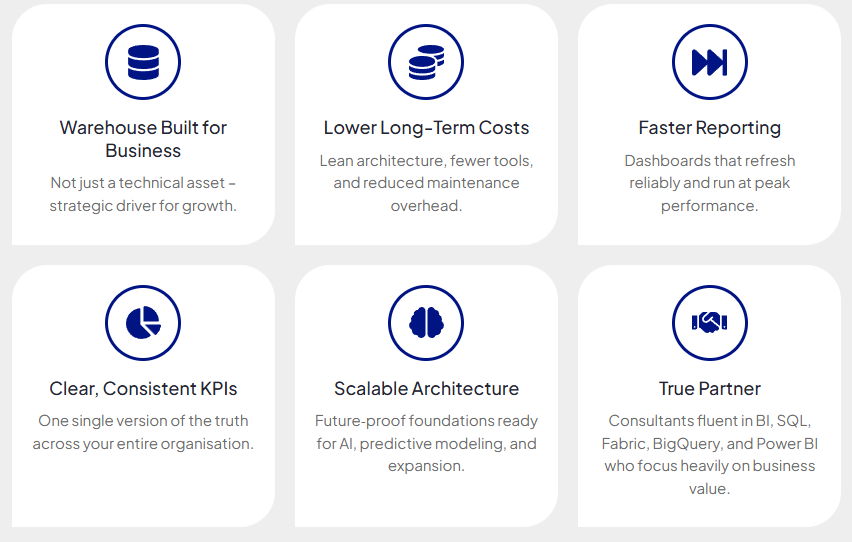
Faster reporting: Dashboards refresh reliably and run quickly.
Lower maintenance cost: Lean architecture = fewer tools = less overhead.
Clear, consistent KPIs: One version of the truth across the organisation.
Scalable architecture: Ready for AI, predictive modelling, and future growth.
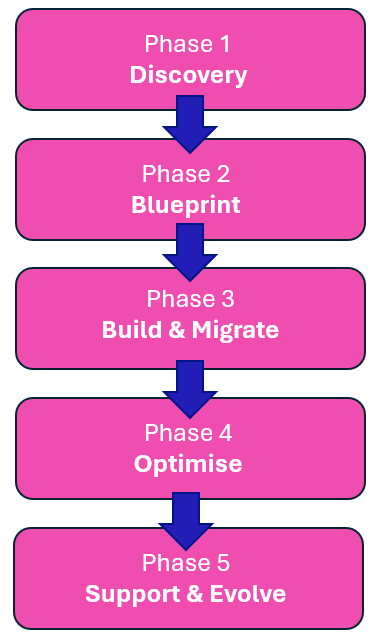
6. A Practical Roadmap for Modernisation
Discovery: Audit current architecture, identify bottlenecks, map business objectives, and define KPIs.
Blueprint: Design layers, choose platform (Fabric or BigQuery), and define governance.
Build & Migrate: Implement pipelines, build semantic layer, rebuild dashboards.
Optimise: Improve performance, reduce compute costs, and add data quality tests.
Support & Evolve: Governance, monitoring, enhancements, and AI readiness.
7. When You Should Modernise
You should modernise your warehouse if reporting is slow, you have multiple versions of the truth, your SQL environment is ageing, or you want to support AI and predictive analytics.
8. Conclusion
A modern data warehouse is not just a technical upgrade — it’s a strategic investment. The organisations that succeed start with business outcomes, build a clean semantic layer, and modernise incrementally.
Book a Data Warehouse Strategy Session
If you want a clear roadmap, cost estimate, and architecture blueprint tailored to your business, we can help.
You’ve seen the overview — now get the complete blueprint with architecture diagrams, KPI governance, and the AI agent layer. Download the free PDF