

Most businesses don’t have a reporting problem.
They have a trust problem.
Dashboards have been built. Reports are delivered on time. Performance metrics are available across the organisation.
Yet leadership meetings still begin with familiar questions:
- Which report is correct?
- Why don’t the numbers match?
- Can we validate these figures before making a decision?
- Where has this number come from?
When these conversations happen regularly, the issue is rarely the reporting tool itself.
More often, the problem lies in the foundations underneath it.
Why Good Management Information Matters?
Management Information (MI) should help leaders make informed decisions quickly and confidently.
Instead, many organisations find themselves spending valuable time validating, reconciling and questioning the information in front of them.
The consequences can be significant:
- Slower decision-making
- Reduced confidence in business performance data
- Conflicting views across departments
- Increased operational risk
- Missed opportunities for improvement and growth
The irony is that many organisations experiencing these challenges already have reporting systems in place. The issue isn’t the lack of information. Instead, organisations often struggle with confidence in the information being reported.
The Seven Hidden Reasons Management Information Fails
In our experience, poor management information can usually be traced back to one or more of these common issues.
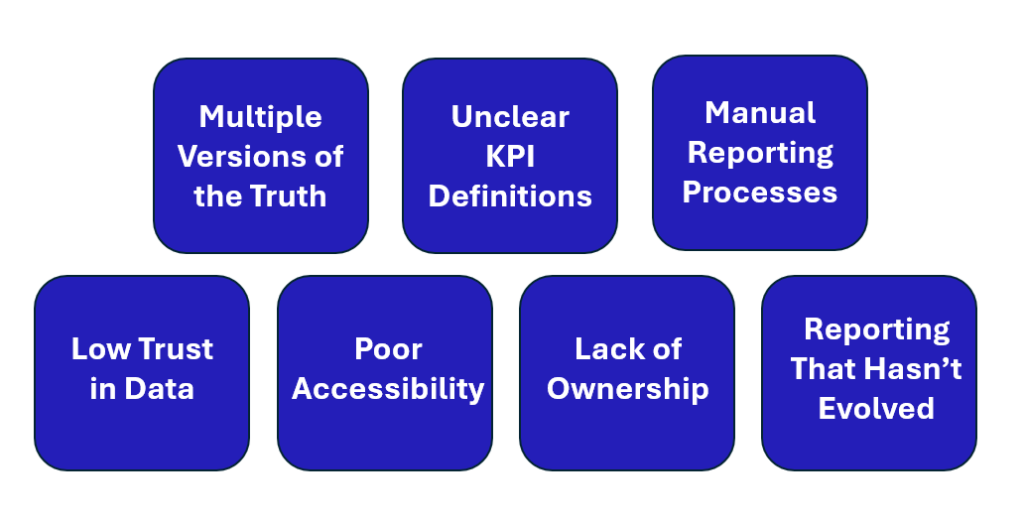
1. Multiple Versions of the Truth
Different departments often produce different figures for the same metric.
Sales, Finance and Operations may all have their own reports, calculations and assumptions.
Without a single source of truth, leadership teams quickly lose confidence in the numbers being presented.
2. Unclear KPI Definitions
What exactly constitutes revenue?
How is profitability calculated?
How is customer performance measured?
If KPI definitions aren’t agreed across the organisation, inconsistent reporting becomes inevitable.
3. Manual Reporting Processes
Many reporting processes still rely on spreadsheets, exports and manual manipulation of data.
These workarounds increase the risk of errors, create delays and make reporting difficult to scale as the business grows.
4. Low Trust in Data
When stakeholders feel the need to validate every report before acting on it, confidence begins to erode.
Eventually, even accurate information becomes questioned because trust in the process has been lost.
5. Poor Accessibility
Management information is most valuable when it is available at the point decisions need to be made.
If decision-makers regularly wait for reports or depend on individuals to provide information, opportunities can be missed and performance impacted.
6. Lack of Ownership
Who owns the data?
How are key metrics defined and governed?
Who is responsible for maintaining reporting standards?
Without clear ownership and governance, reporting environments often become fragmented and difficult to manage.
7. Reporting That Hasn’t Evolved
Businesses change. Strategies evolve. Priorities shift.
Yet many organisations continue to report on yesterday’s priorities rather than today’s challenges.
Management information should evolve alongside the business it supports.
Strong Foundations Create Trusted Management Information
Trusted management information doesn’t happen by accident.
It is built on strong foundations:
- Well-structured data
- Consistent KPI definitions
- Robust processes
- Clear ownership
- Effective governance
When these foundations aren’t in place, organisations often find themselves stuck in a cycle of conflicting reports, manual processes and endless validation. A Management Information Health Check can help identify the underlying issues and prioritise improvements.
When they aren’t, organisations often find themselves stuck in a cycle of conflicting reports, manual processes and endless validation.
The Real Cost of Poor Management Information
The biggest cost isn't inaccurate information. It's the hesitation that follows when decision-makers don't completely trust it.
When confidence in management information is low:
- Strategic decisions are delayed
- Meetings become discussions about data rather than performance
- Time is spent reconciling reports
- Opportunities are missed
- Organisational agility suffers
Even the most sophisticated dashboard cannot overcome a lack of trust in the underlying information.
What Good Management Information Looks Like
Strong management information isn’t defined by impressive dashboards.
It’s defined by confidence.
High-performing organisations typically have:
- A single source of truth
- Consistent KPI definitions
- Trusted and reliable data
- Clear ownership and governance
- Information that’s available when needed
- Reporting aligned to business objectives
As a result, leadership teams spend less time validating information and more time making decisions.
A Simple Question
Would your leadership team make an important business decision today without first questioning the numbers?
If the answer isn’t an immediate yes, a Management Information Health Check can help uncover the issues affecting trust, consistency and confidence in your reporting environment.
More often, the real challenge sits beneath the reporting layer in the data, processes and governance that support it.
Management Information Health Check
Our Management Information Health Check helps organisations identify the issues affecting trust, consistency and confidence in their reporting environment.
The objective isn’t simply better reporting.
It’s creating trusted management information that supports confident decision-making across the business.
Discover what’s preventing your leadership team from fully trusting its management information.
Frequently Asked Questions
What is management information?
Management information (MI) is the combination of business data, reports and performance metrics used by leaders to monitor performance, identify trends and support decision-making.
Why does management information fail?
Management information typically fails because of issues with the underlying data, processes and governance rather than the reporting tool itself. Common causes include inconsistent data sources, unclear KPI definitions, manual reporting processes and a lack of trust in the information being reported.
How can organisations improve management information?
Improving management information starts with creating a single source of truth, establishing consistent KPI definitions, strengthening data governance and ensuring clear ownership of both data and reporting.